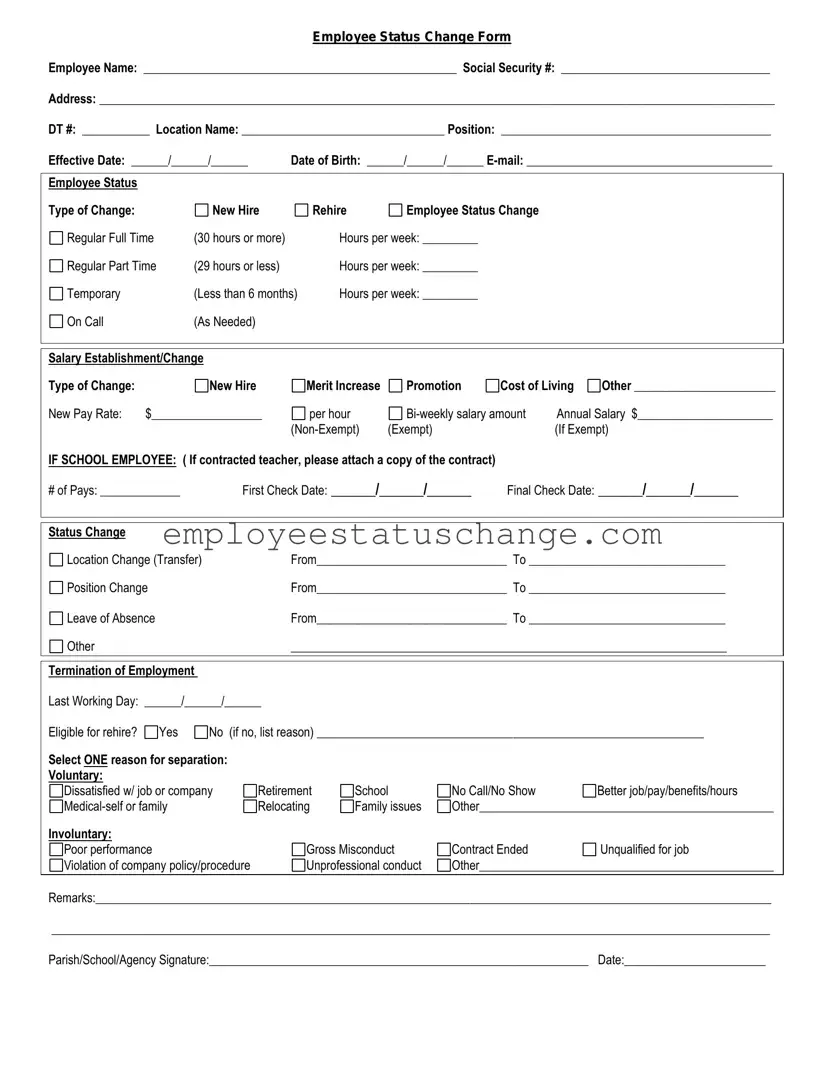
Get Employee Status Change Form in PDF
Common mistakes
When filling out the Employee Status Change form, individuals often overlook crucial details that can lead to complications later on. One common mistake is failing to provide accurate personal information. It might seem trivial, but even a small error in a name or address can create significant issues in payroll and benefits administration. Ensuring that all personal data is correct and up-to-date is essential for a smooth transition.
Another frequent error involves neglecting to specify the reason for the status change. Whether it’s a promotion, transfer, or resignation, clearly stating the reason helps HR understand the context of the change. Without this information, processing the request may take longer than necessary, leading to confusion and delays in updating employee records.
Additionally, many individuals forget to include the effective date of the change. This date is critical as it determines when the new status takes effect. If the effective date is missing or incorrect, it can lead to discrepancies in pay and benefits. Timeliness is key, and including this detail ensures that all parties are aligned on the timeline.
Another common pitfall is not obtaining the necessary approvals before submitting the form. Many organizations require signatures from supervisors or HR representatives. Failing to secure these approvals can result in the form being rejected or delayed. It's important to familiarize oneself with the company’s procedures to avoid unnecessary setbacks.
Lastly, individuals often overlook the importance of reviewing the entire form before submission. Rushing through the process can lead to missed errors or incomplete sections. Taking the time to double-check the form ensures that all required information is provided and accurate. This simple step can save time and prevent potential issues down the line.
Similar forms
The Employee Status Change form is similar to the Job Offer Letter. Both documents serve as official communications regarding employment changes. A Job Offer Letter outlines the terms of employment, including job title, salary, and start date, while the Employee Status Change form details modifications to an employee's current status, such as promotions, transfers, or terminations. Each document requires signatures to confirm acceptance and understanding, ensuring clarity and agreement between the employer and employee.
Another document that resembles the Employee Status Change form is the Termination Notice. This document formally communicates the end of an employee's tenure with a company. Like the Employee Status Change form, the Termination Notice includes essential details such as the last working day and any relevant information regarding final pay and benefits. Both documents aim to provide clear communication about changes in employment status, ensuring that employees are informed of their rights and responsibilities.
The Performance Review form also shares similarities with the Employee Status Change form. While the Employee Status Change form focuses on changes in employment status, the Performance Review assesses an employee's job performance over a specific period. Both documents are crucial for human resources management and require careful documentation. They help track an employee's progress and inform decisions about promotions or other status changes based on performance evaluations.
Lastly, the Leave of Absence Request form is akin to the Employee Status Change form in that it addresses temporary changes in an employee's work status. This form allows employees to formally request time away from work for various reasons, such as medical issues or personal matters. Like the Employee Status Change form, it requires approval from management and outlines the duration of the leave, ensuring that both the employer and employee understand the implications of the requested change.
Key takeaways
Filling out and using the Employee Status Change form is an important process for both employees and employers. Here are some key takeaways to keep in mind:
- Ensure that all sections of the form are completed accurately. Missing information can delay the processing of the change.
- Review the form for any required signatures before submission. This may include approvals from direct supervisors or HR representatives.
- Submit the form promptly after the change occurs. Timeliness helps maintain accurate records and ensures that any necessary adjustments are made in a timely manner.
- Keep a copy of the completed form for personal records. This can be useful for future reference or in case of discrepancies.
- Understand the specific reasons for the status change, whether it’s a promotion, demotion, transfer, or leave of absence. This clarity can help in communicating with HR and other departments.
- Be aware of the potential impact of the status change on benefits, pay, and job responsibilities. It’s advisable to discuss these aspects with HR if there are any uncertainties.
- Follow up with HR after submitting the form to confirm that the change has been processed. This ensures that all records are updated accordingly.
File Data
| Fact Name | Description |
|---|---|
| Purpose | The Employee Status Change form is used to document changes in an employee's job status, such as promotions, transfers, or terminations. |
| Who Uses It | This form is typically completed by HR personnel or a manager and submitted to the HR department for processing. |
| Required Information | Key details include employee name, employee ID, current position, new position, and the effective date of the change. |
| Employee Consent | In many cases, the employee's signature may be required to acknowledge the change and its implications. |
| State-Specific Forms | Some states may have specific requirements or additional forms that must accompany the Employee Status Change form. |
| Governing Laws | In California, for instance, the form must comply with the California Labor Code regarding employment records. |
| Record Keeping | Employers are required to maintain records of all status changes for a specified period, often dictated by state law. |
| Impact on Benefits | Changes in status can affect employee benefits, such as health insurance and retirement plans, necessitating timely updates. |
| Submission Process | The completed form should be submitted to HR and may need to be filed in the employee's personnel record. |
| Review Timeline | HR typically reviews submitted forms within a specified timeframe to ensure all changes are accurately processed. |
Understanding Employee Status Change
-
What is the Employee Status Change form?
The Employee Status Change form is a document used by employers to formally record any changes to an employee's status within the organization. This could include promotions, demotions, transfers, terminations, or changes in employment status such as full-time to part-time.
-
When should I fill out this form?
You should complete the Employee Status Change form whenever there is a significant change in your employment status. This ensures that the company’s records are up-to-date and that any necessary adjustments to benefits, payroll, or job responsibilities are made promptly.
-
Who is responsible for submitting the form?
Typically, the employee's supervisor or manager is responsible for submitting the form. However, employees can also initiate the process by discussing their status change with their supervisor and ensuring that the form is completed and submitted appropriately.
-
What information is required on the form?
The form generally requires the following information:
- Employee's name and ID number
- Current job title and department
- Details of the status change (e.g., promotion, transfer)
- Effective date of the change
- Signature of the supervisor or manager
-
How does a status change affect my benefits?
A change in employment status may impact your benefits. For instance, moving from full-time to part-time status might reduce your eligibility for certain benefits like health insurance. It’s important to review your benefits package and consult with HR to understand the implications of your change.
-
What happens after I submit the form?
Once submitted, the form is typically reviewed by the HR department. They will update your employment records accordingly and inform you of any changes to your pay, benefits, or job responsibilities. You may also receive confirmation of the status change.
-
Can I appeal a status change decision?
If you disagree with a status change decision, you may have the option to appeal. This process usually involves discussing your concerns with your supervisor or HR department. Each company may have different procedures for handling appeals, so it's best to consult your employee handbook or HR for guidance.
-
Is there a deadline for submitting the form?
While deadlines may vary by company policy, it is generally advisable to submit the Employee Status Change form as soon as the change occurs or is agreed upon. Prompt submission helps ensure that all necessary adjustments are made in a timely manner.
-
What if I lose the form?
If you lose the Employee Status Change form, don't worry. You can typically obtain another copy from your HR department or through your company's internal systems. It's important to keep a copy for your records once it has been completed and submitted.
-
Where can I find the Employee Status Change form?
The form is usually available on your company’s intranet or HR portal. If you cannot locate it, reach out to your HR department for assistance. They can provide you with the most current version and any specific instructions for filling it out.
Misconceptions
Misconceptions about the Employee Status Change form can lead to confusion among employees and management. Below are five common misconceptions along with explanations to clarify each point.
- The form is only for terminations. Many people believe that the Employee Status Change form is solely for documenting terminations. In reality, this form is used for various changes, including promotions, transfers, and changes in job titles or responsibilities.
- Only HR can submit the form. Some employees think that only Human Resources can initiate the Employee Status Change form. However, managers and supervisors can also submit the form when they identify a need for a status change within their team.
- Submitting the form guarantees immediate changes. There is a misconception that once the Employee Status Change form is submitted, changes will take effect immediately. Approval processes may be required, and changes often take time to implement.
- The form is optional. Some employees may believe that completing the Employee Status Change form is optional. In fact, it is a necessary document to ensure that all changes are officially recorded and processed in the company’s systems.
- Only full-time employees need to fill out the form. It is often assumed that only full-time employees are required to complete the Employee Status Change form. However, part-time employees and contractors may also need to submit this form for any status changes affecting their employment.
How to Fill Out Employee Status Change
After completing the Employee Status Change form, it will be submitted to your HR department for processing. They will review the information and make any necessary updates to your employment records. Ensure that all details are accurate to avoid delays.
- Begin by entering your full name in the designated field.
- Provide your employee ID number, if applicable.
- Select your current job title from the drop-down menu.
- Indicate the reason for the status change by checking the appropriate box.
- Fill in the effective date of the change.
- Provide any additional comments or notes in the space provided.
- Review the form for accuracy before submission.
- Sign and date the form at the bottom.
Document Preview Example

Employee Status Change Form
Employee Name: ___________________________________________________ Social Security #: __________________________________
Address: ______________________________________________________________________________________________________________
DT #: ___________ Location Name: _________________________________ Position: ____________________________________________
Effective Date: ______/______/______ |
Date of Birth: ______/______/______ |
|||
|
|
|
|
|
Employee Status |
|
|
|
|
Type of Change: |
New Hire |
|
Rehire |
Employee Status Change |
Regular Full Time |
(30 hours or more) |
|
Hours per week: _________ |
|
Regular Part Time |
(29 hours or less) |
|
Hours per week: _________ |
|
Temporary |
(Less than 6 months) |
Hours per week: _________ |
||
On Call |
(As Needed) |
|
|
|
|
|
|
|
|
Salary Establishment/Change |
|
|
|
|
|
|
|
|
|
|
Type of Change: |
|
New Hire |
|
Merit Increase |
Promotion |
Cost of Living |
Other _______________________ |
|||
New Pay Rate: |
$__________________ |
per hour |
|
Annual Salary $______________________ |
||||||
|
|
|
|
(Exempt) |
|
|
(If Exempt) |
|||
IF SCHOOL EMPLOYEE: ( If contracted teacher, please attach a copy of the contract) |
|
|
|
|||||||
# of Pays: _____________ |
First Check Date: ______/______/______ |
Final Check Date: ______/______/______ |
||||||||
|
|
|
|
|
|
|
|
|
|
|
|
|
|
|
|
|
|
|
|
|
|
Status Change |
|
|
|
|
|
|
|
|
|
|
Location Change (Transfer) |
|
|
From_______________________________ To ________________________________ |
|||||||
Position Change |
|
|
From_______________________________ To ________________________________ |
|||||||
Leave of Absence |
|
|
From_______________________________ To ________________________________ |
|||||||
Other |
|
|
|
_______________________________________________________________________ |
||||||
|
|
|
|
|
|
|
|
|
|
|
Termination of Employment |
|
|
|
|
|
|
|
|
|
|
Last Working Day: ______/______/______ |
|
|
|
|
|
|
|
|||
Eligible for rehire? |
Yes |
No (if no, list reason) _______________________________________________________________ |
||||||||
Select ONE reason for separation: |
|
|
|
|
|
|
|
|
||
Voluntary: |
|
|
|
|
|
|
|
|
|
|
Dissatisfied w/ job or company |
Retirement |
School |
No Call/No Show |
|
Better job/pay/benefits/hours |
|||||
|
Relocating |
Family issues |
Other________________________________________________ |
|||||||
Involuntary: |
|
|
|
|
|
|
|
|
|
|
Poor performance |
|
|
Gross Misconduct |
Contract Ended |
|
Unqualified for job |
||||
Violation of company policy/procedure |
|
Unprofessional conduct |
Other________________________________________________ |
|||||||
|
|
|
|
|
|
|
|
|
|
|
Remarks:______________________________________________________________________________________________________________
_____________________________________________________________________________________________________________________
Parish/School/Agency Signature:______________________________________________________________ Date:_______________________